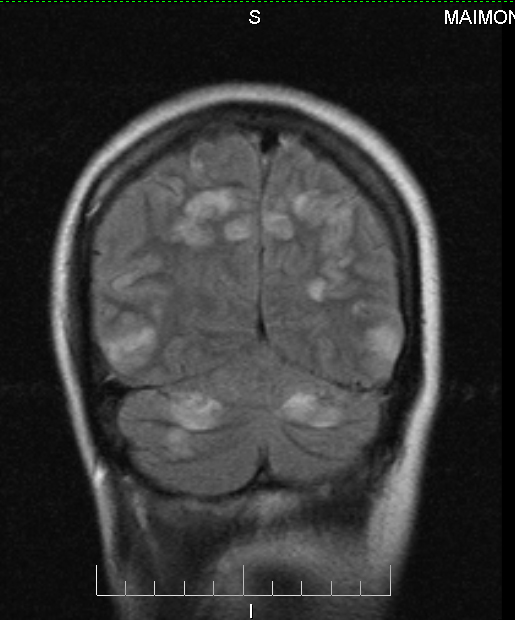
Brain tumors: going over the basics

Recently I have seen many patients with brain tumors in my office and that shall be the focus of my post.  Brain tumors are tumors (cancers) that arise in the brain or spread to the brain. We call these primary brain tumors (tumors arising in the brain itself) or metastatic tumors to the brain (the primary tumor/ cancer is somewhere else for example in the lung or breast but then spreads to the brain).

Let us now spend a moment to talk about how brain tumors present clinically. Many of you shall be surprised to learn that the brain itself is insensitive to pain (meaning if I was to put a knife through your brain tissue, you shall feel no pain!!!).  So a small brain tumor may be silent, causing no pain or discomfort. It is usually when the brain tumor increases in size and starts involving (stretching the blood vessels in the brain) or the covering of the brain (meninges) that the patient may complain of headache. Blood vessels and covering of the brain (meninges) are richly supplied by nerves and hence are exquisitely pain sensitive.  So first and foremost not all brain tumors present with headache. The corollary to that is that not all headaches are due to brain tumors. Most of the times when patients present to a doctor for evaluation of headache, a “benign” cause such as migraine or tension headache is found and not a brain tumor.

If I am examining a patient with headache, there are certain red-flags in the history and the examination which shall make me think about a possible brain tumor.

Laterality of the headache:  Headaches associated with brain tumors are usually holocranial (the whole head hurts). Remember migraines are typically hemicranial (patient complains of a throbbing headache on one side of the head). This though is not a hard and fast rule and I would not base my opinion on the laterality of the headache.

Is the headache associated with projectile vomiting: Because a large brain tumor  shall lead to an increase in the intracranial pressure (pressure inside the brain),  patients with brain tumors may have projectile vomiting. This again is not a hard and fast rule as patients with migraines are frequently nauseated and may throw up.

Does the headache awaken the patient at night from sleep? Headache associated with brain tumor may awaken the patient from sleep. Classically the headache is worst when lying down and abates in the morning when the patient gets up and starts to move around. Migraines usually do not awaken a patient from sleep, infact sleep frequently helps to abort a mgraine attack. Again a weak point and I would not base my opinion on this alone.

History! History! History!: 

Let us compare two different histories in two patients:

Patient number 1 (age=53 years male)

“Dr Sethi, I have never had a headache in my life, never had a headache in my adolescence but recently I am waking up with a severe headache.”–THE THOUGHT OF BRAIN TUMOR DOES CROSS MY MIND WHEN I HEAR THIS

Compare this to:

Patient number 2 (age 26 years female)

“Dr Sethi, I have headaches since my college days. Frequently I shall get a throbbing headache on one side of my head and at that time bright lights shall bother me. I used to feel nauseated when I had my headaches and at times threw up. My headaches went away in my 30s but now I am again having bad headaches” –MIGRAINE IS THE FIRST THOUGHT THAT CROSSES MY HEAD AND NOT BRAIN TUMOR.

Other presentations of brain tumors: brain tumors at times may present more dramatically. Patients may present with a generalized convulsion. When these patients are imaged (via a CT scan or a MRI brain scan) the brain tumor may be detected. At times patients present with progressive neurological deficits. The type of neurological deficit depends frequently on the location of the brain tumor. Let me explain this further. Let us assume the brain tumor is pressing on the optic nerve or other nerves which control eye-movements: patients may present with visual problems (such as blurring of vision, double vision or diplopia, cuts in their visual fields and so forth). If the tumor presses on the motor or sensory system: patients may present with weakness or numbness on the contralateral side of the body. If the tumor is in the cerebellum, they shall complain of balance problems or lack of coordination. If the tumor involves the auditory nerve, their presenting complaint shall be of hearing loss (usually though unilateral hearing loss may not be appreciated by the patient).

Finally the neurological examination is of great help. Patients with migraines, tension type headaches and other “benign” headaches have a normal (we call this non-focal) neurological examination. On the other patients with brain tumors may have some subtle and other more prominent neurological findings. Thus your doctor shall examine you: check your cranial nerves (does the patient have a symmetrical smile, are eye-movements intact, is the visual field intact, do thay have any sign of increased pressure inside the brain (this is determined by looking into the eye to visualize the optic nerve head), is motor strength and sensory system intact,  are there any signs of cerebellar dysfunction (incoordination, ataxia–balance is off and so forth).

Patients with headaches who have an abnormal neurological examination should be imaged. Your doctor may then recommend either a CT scan of the head or a MRI scan. Frequently this is done with and without contrast. I shall dwell into different types of brain tumors and their management in my next post.

Nitin Sethi, MD

Persistent vegetative state or Minimally conscious state: a question and an answer

Dear Dr. SethiI am really confused and I would be very grateful if you could help me. My 40 years old brother had a car accident six months ago and suffered a diffuse axonal injury. He was a university teacher, very intelligent. He is slowly improving and his evolution is very similar to what you described in your first post. Now he looks to where we ask him to look but he does not respond to other verbal commands. The doctors sent him home 2 weeks ago and did not say if he is PVS or MCS. We do not have good care centers in the city and the neurologists said there is nothing we can do to help him. We should just feed him and avoid infections. He is getting good physical therapy, now. We talk to him a lot, he watches TV and listens to music. We even give him small quantities of sauces and juices to stimulate his taste. We believe that our love will help him more than being away from his family in a rehab center. But we are afraid of doing less than we should. Are the neurologists right? Is it possible to provide enough stimulation at home? Is there any literature to guide us on this path? Thank you very much for your attention. By the way, we live in Brazil and I apologize for the bad english.

c
braindiseases Dear C,
thank you for writing in to me. I apologize for the delay in my reply. As I stated in my posts, it is at times indeed difficult to prognosticate about patients who have suffered a traumatic brain injury. You say your brother’s neuroimaging studies showed diffuse axonal injury (DAI).
I shall not use words like PVS or MCS. I shall try to explain a few things with examples. So here goes and I speak from your perspective.1. Just what is the level of my brother’s consciousness. Is he fully consciousness or is he not. There are different grades of consciousness–people use words like comatosed, semi-comatosed, drowsy, somolent, sleepy)
2. He may be conscious but not aware ( consciousness is intact but there is no awareness. By awareness I mean to one’s own need like hunger, a full bladder and so forth. Is he aware he is hungry? Is he aware he has a full bladder and needs to void? Awareness about surroundings. Who is that person standing next to me? Is that my sister?)
3. He is conscious with limited awareness. There are days or moments in a day when he seems more aware. He smiled at you when you came to see him today. He said or attempted to say something. He squeezed your hand.

So as you can see these disorders of consciousness are very fluid conditions. The brain is not static. There are patients who may be in one stage and may progress or deteriorate into another state. As neurologists we are now acutely aware of how limited our understanding is of these disorders of consciousness.

So this is what I advise:
1. Firstly you are dealing with an extremely tough condition. One that unfortunately has no good treatment or possibly outcome. So hang in there and have faith.
2. He should be assessed by his neurologist at some future date. Remember what I said above. Patients evolve and their neurological examination changes.
3. Stimulation cannot hurt him and so interacting with your brother is good.
4. Infections like pneumonia (patients usually have a weak cough reflex and may aspirate their food leading to a lung infection), bed sores and urinary tract infection are the main things you need to watch out for. These frequently lead to poor outcomes and hence should be aggressively identified and treated.
5. Good physical therapy forms the cornerstone of any treatment regime. I would encourage that. Maybe he can go for physical therapy once or twice a week. Rest of the days, it can be done at home.
6. There is hope on the way. New research is been done. There are recent reports of improved outcome/ dramatic improvement in patients in MCS who underwent neurostimulation.

I hope I have been of help to you.

Personal Regards,
Nitin Sethi, MD

Infantile spasms: a few questions and answers


Dear Dr,
My son is diagnosed with hypsarhythmia and he is 18 months. As of now we do not see notice any delay in his development.Is there a chance for developmental delay?? He is on ACTH treatment. His symptoms are Head Dropping.

Thank You!
R


braindiseases


Dear Mr.R ,
thank you for writing in to me. I am happy to learn that your son is doing so well and that you have not noticed any developmental delay or developmental regression. It suggests that his infantile spasms are well controlled. My advise would be to keep him under the close observation of his pediatrician and pediatric neurologist. At some point of time, they might like to repeat his EEG to assess seizure control. Sometimes a prolonged EEG study is very useful in this regard.

Personal Regards,
Nitin Sethi, MD


K


Hi There,
Our daughter is 18months, has had infantile spams since 2wks old. We have tried phenobarb, vigabatrin, nitrazepam, topirimate, b6, clobezam, epilim, lamotrigine & prednisolone. None have worked on our wee girl, her development is so far behind, she can sit & thats all, no reaching out, focusing etc. I am at my wits end with what to do next, Paeds dont seem to be really trying to get her sorted, Mri came back with no abnormalities, shes had bloods, urine & lumber puncture, all clear. Eegs show a lot of electrical activity. What do you think we should do? Im really wanting to get a second opinion & someone that will help us.
Cheers


braindiseases


Dear K,
thank you for writing in to me. From what you tell me it seems your daughter’s seizures have proven to be refractory to multiple anticonvulsant drugs. Extensive investigative work-up revealed no cause for her infantile spasms. We call this condition cryptogenic or idiopathic infantile spasms (cryptogenic because a cause for infantile spasms is suspected but has not been identified).
I can understand your frustration K. This is what I advise. It might be worth the time and effort to have her evaluated at a comprehensive epilepsy center. Special diets like the ketogenic diet at times work wonders. Also some new drugs are now available. Acthar (ACTH) gel at times works–though it is frightfully expensive and may not be covered by insurance. Neurostimulation devices like the vagus nerve stimulator (VNS) can be tried though to my knowledge there is little data on its efficacy in infantile spasms.

Personal Regards,
Nitin Sethi, MD


Seizures due to hypoglycemia–a couple of questions and answers.

I got a few insightful questions from my readers which I am sharing here. My reply to them follows.

K

Is it possible to have hypoglycemia and suffer with seizures without diabetes?

My Blood sugar level after a seizure is high though quickly drops down (Shock?)

Can Hypoglycemia be a random problem caused by diet at the time and stress etc?

 
  braindiseases  

Dear K,
thank you for writing in. You ask a good question. There can be many causes of hypoglycemia, diabetes mellitus is one of the more common causes. In diabetes mellitus hypoglycemia commonly occurs in the setting of a missed meal (by that I mean, a diabetic patient takes his anti-diabetic medication/ insulin but forgets to take his meal). Another setting may be if one has what is called brittle diabetes. This is a condition in which the blood sugar varies quite a lot. Such patients need fine control of their blood sugar level to prevent episodes of hypoglycemia or hyperglycemia.
Seizures occur due to hypoglycemia per se (low blood sugar), not because of hypoglycemia due to diabetes. What I mean to say is that hypoglycemia due to any cause can cause a seizure provided the blood sugar falls below a critical level (usually less than 50 mg/dl).
Personal Regards,
Nitin Sethi, MD

  S  

hi
im not here to ask a question sorry, just to ponder your mind a little,
ive had type 1 diabetes since the age of 4 (16 years) and i am now 20. when i was 7 i had my 1st seizure. time went on and since ive been 15 ive had around 20 + full on seizures ive had 2 in the street both ive recovered from, but the rest was in my sleep, with no warning atall. i go ridged and ALWAYS bite my tounge and injure myself, suck as banged my head off the cooker, the floor, raidiator etc. after this happens i get sugar rubbed in my gums by my family or friends till i come round, (no paramedic or hospital service involed) but the confusing thing was when i had them in the street and i came around WITHOUT sugar or anything. witch was also confusing for the hospital and my gp. witch also brings me to my next thing.
ive been to my local gp and also im back attending the hospital on a weekly basis.
as ive now been to see my gp today, and gave him details etc. of each seizure. hes now under the idea of sending me to a neurologist as he dosent beleive that my seizures are in anyway linked to my diabetes.
also ive just had my insulin changed from human mixtard 30 (twice daily) to lantus(morning) & novo rapid(breakfast, lunch, dinner).

what i was wondering was, what your thoughts would be on this ?

 
  braindiseases  

Dear S,
thank you for writing in. This is what I feel. I think it shall be worth your time to see a neurologist and get a thorough evaluation for your seizure disorder. Some of your seizures likely can be accounted for by hypoglycemia (the ones in which you make a rapid recovery when sugar is rubbed onto your gums). It is also possible that you have underlying epilepsy/ seizure disorder. This may result in convulsions which are unrelated to hypoglycemic episodes. Also why should you be having hypoglycemia induced seizures if your diabetes is well controlled? As you can understand there are bits in your history which do not “gel”.
So I feel you need a good work-up. A neuroimaging study of the brain (ideally a MRI scan of the brain) and an electroencephalogram (EEG study) may be warranted. Your doctor may then decide to treat you with an anti-convulsant medication.

Personal Regards,
Nitin Sethi, MD


Syncope Vs Seizure: the quest for an answer

One of the readers of my blog sent me an interesting query. Here is her history. My response to it follows. I have deleted her name and hidden her email address to maintain her confidentiality.


HISTORY

Hi! I was grocery shopping in Wal-mart when I had my episode. I was walking to the front of the store after shopping for about an hour. My vision kept blacking out. It was like someone just turned out the lights. I would be able to see again and I would be standing there staring at something. This happened about 4 or 5 times over a ten minute span. The next thing I knew I was waking up in the hospital. Apparently I hit the ground started convulsing, my eyes rolled back and I was foaming at the mouth. I bit the side of my tongue, my body was horribly sore the next couple of days, but I didn’t have any bladder issues. I had no memory of the seizure or what had happened. I kept going in and hour for the next couple of hours. I busted my head on the floor which required staples. I had memory problems and balance issues for the next week. I then made an appointment with a neurologist. He thinks I have syncope. He sent me for my EEG to rule out epilepsy, but we haven’t got the results back yet. While I was having my EEG I started having facial spasms during the flashing light portion of the test. I’m reading about syncope and some of it just doesn’t fit. I am a HUGE salt eater. I crave salty foods all day! So if that was it, wouldn’t my diet be treating the syncope? Also, my sister has epilepsy. Her seizures are triggered by flashing lights. I have never had a seizure before. I have passed out in the past, but it was because of hypoglycemia. I don’t have any issues with heat or pain or seeing blood. It just doesn’t affect me. I just don’t know if he’s got the correct diagnosis and would like someone else’s opinion. Thanks!

Dear A,
                 thank you for writing in to me.  Your history has intrigued me and hence I shall dwell over it a little before offering my humble opinion.  It goes without saying, this opinion is offered without taking your history in person and examining you.  You should follow what your doctor tells you.  He/ she shall be the best person to guide further diagnostic and management issues.  Your recent event had features of both syncope as well as a seizure/ convulsion. So what in your history points towards syncope?
PRODROMAL FEATURES: meaning things which you felt prior to passing out. You felt light headed, your vision was blurred/ tunneled/ kept going in and out (it always fascinates me how patients use different words to describe the same symptom). Prior to a syncopal event patients may feel as if they are about to pass out/ faint. They may look pale (all the blood was drained out from the face), they may feel/ complain that their legs feel weak/ woobly.
I am uncertain what to make of the staring episodes which followed soon after. By staring do you mean you were unable to concentrate (may occur with syncope) or do you mean you had impairment in your level of consciousness and awareness ( goes more towards a seizure).
Anyways let us move forward. The next thing you remember is waking up in the hospital. From the bystander history, you were noticed to have convulsive movements. During the seizure, you lost body tone leading to a hard fall which cracked open your skull.  During the convulsion itself your eyes rolled back into your head, you foamed from the side of the mouth and bit the side of your tongue. Yes biting the side of the tongue goes more towards a seizure than biting the tip of your tongue. I am not sure who figured that one out though. You did not have loss of bladder control. Post the seizure, you were not yourself  for the next few days with a slow return to the baseline.
There I think I have summarized your history well. Well what happens next? Your history has features of both syncope as well a seizure.  I would have asked a few more questions:
1) did you feel anything prior to the event. We call these auras. Any strange smell, any strange taste and so forth.
2) have you ever had a seizure before.
3) any history of febrile convulsions?
4) are you prone to syncope: were you dehydrated, sick with the flu and so forth.
Well let us move forward. I am taking you step by step as I work through this history. So the doctor ordered an EEG (test to look at the brain waves). Why the EEG? Well simple if the EEG shows abnormal brain waves (I use the word misfiring of the brain), it points towards a seizure. If the EEG is normal, it may point towards syncope. That said and done, patients with seizures may have a normal EEG.
We do not have the EEG results. But during the test you mention something happened to you. Your face started twitching while photic stimulation was been carried out (flashing lights). Your sister has epilepsy and you say her seizures are triggered by flashing lights (usually patients who have primary generalized epilepsy have these kind of seizures).
So where does all this lead to?  My opinion: it is possible you have an underlying seizure disorder.
My recommendations: I would try my level best to rule out or rule in seizures. This may need a longer duration EEG study, if the first one is unrevealing. The decision to start anti-convulsant therapy shall be guided by all the above : history, examination findings, EEG findings and neuroimaging findings (CT scan or MRI brain).
THE BEST PERSON TO MAKE THAT DECISION–YOUR CURRENT DOCTOR AND NOT ME OVER THE INTERNET.  

When a seizure is not a seizure (pseudoseizures)

When a seizure is not a seizure (pseudoseizures)

Nitin K Sethi, MD

Assistant Professor of Neurology

New York-Presbyterian Hospital

Weill Cornell Medical Center

New York, NY 10065

The month of Feb finds me in New Delhi, India. I have been invited to present a talk on psychogenic non-epileptic seizures (PNES). You may now be wondering what does that mean. Well that is what I plan to discuss in this post of mine. Let us look at the term again:

P–stands for psychogenic  meaning the event has a psychological basis to its existence.

NES–stands for non-epileptic seizure meaning the event is not a epileptic seizure.

So let me put it all together in simple language.  Let us assume our character for this short story is Michelle. Now Michelle is a 25-year-old young lady who is married to John. All looks great from outside. Michelle has a good job, a fun life in Manhattan and a good circle of friends. But all is not hunky dory. Michelle and John have been having some problems. John is verbally and lately physically abusive to her. Michelle feels trapped in a loveless marriage but sees no way out.

So one day Michelle and John are at a dinner party.  Seated at their table are few close friends as well as some strangers. As the main course is served, Michelle suddenly leans back, she utters a cry. Then her eyes are noticed to roll up.  John and Michelle’s friends quickly ease her to the ground. She is then noted to have vigorous side to side shaking movements of her head, asynchronous out of phase thrashing movements of her arms and legs. All this time her eyes are open and she is muttering help me, help me.

Michelle is rushed to the hospital where a doctor like me is called to consult on her.  What happened to Michelle?  Seizure or not a seizure, is the question. To help determine the etiology, her doctor orders a video-EEG study.  Michelle is admitted to the hospital and electrodes are pasted on the top of her head to record her brain waves (encephalogram). The encephalogram is time locked to the video camera mounted on the ceiling which records Michelle’s movements. Hence the name VIDEO-EEG.

So imagine Michelle. Sitting in bed, wires attached to her head, surrounded by friends, family and most importantly an extremely concerned John by her bedside. And then it happens again. A dramatic event where she yells a bone chilling cry and then shakes all over.  Now everyone wants to know what is plaguing Michelle.

So what did the video-EEG record?  Was it a seizure or not? Surprisingly when the EEG data is analysed, at the time when Michelle is having her “seizure” the EEG shows no change in the brain waves.  Meaning than Michelle is not having a true seizure, the event is non-epileptic.

Events such as the above are called PNES. They are psychogenic since they have a psychological basis to them. In Michelle’s case they likely reflect her struggles in her marriage and may be a sign for help. Some patients have psychogenic seizures/ pseudoseizures voluntary.  Meaning they might malinger a “seizure” for a secondary gain such as to get social security payments, to escape school and so forth.

PNES  are common and difficult to diagnose and treat.  As you may imagine patients are frequently misdiagnosed. Some are misdiagnosed as true seizures/ epilepsy and started on anti-convulsant drugs which have their own side-effects.  When one drug fails to stop the “seizure”, new drugs are tried.  So frequently these patients are on multiple anti-convulsants and their “seizures” still continue.

PNES do not stop till the underlying psychological issues are tackled. In Michelle’s case simply telling her that she does not have true seizures is not the end of the road. She needs to be referred to a psychiatrist and a therapist. Only then she may be cured.

Post traumatic epilepsy: a question and an answer

One of the readers of my blog asked me a question regarding her son. I am reproducing her question here. My answer to it follows.

V

my son was involved in a car crash 3 years ago aged 17 years and required brain surgery to remove a bloodclot. He recovered well with no ill effects. He had his first fit in November 2009. He had another 2 that same month. CT and MRI scans clear but eeg showed slight abnomal waves over area of surgery. Neuroligist said our choice if wanted to be on medication. Last fit was 27th November 2009 but he has just had another on 8th February whilst flying to holiday Do you thnk meds should be started to prevent further fits.

Dear V,

                    thank you for writing in to me. Your son’s condition is consistent with what is called post traumatic epilepsy. Let me attempt to explain this a little further. Your son obviously was not born with a seizure disorder (epilepsy). He was apparently well till he was involved in a motor vehicle accident (MVA). As a result of the MVA, he suffered head injury and from what you decribe an intracranial hematoma (blood clot) which required evacuation (removal of the blood clot surgically). He had an uneventful recovery but soon there-after had his first convulsion (you do not mention the time interval between the head trauma and the first convulsion).

As the name suggests post traumatic epilepsy refers to epilepsy/ seizure disorder which occurs after head trauma. Usually for post traumatic epilepsy to occur, the head trauma has to be significant such as a motor vehicle accident with significant intracranial hemorrhage or head injuries sustained in the battle field. Many of our soldiers returning from the battlefields of Afghanistan and Iraq suffer bullet shot injuries to the head (these as you can imagine are penetrating head injuries and cause significant brain damage as the high velocity bullet traverses through the skull). IED (improvised explosive devices) related blast injuries cause closed but still significant head trauma and are the signature injury of these two wars. Many of these brave men and women later develop post traumatic seizure disorder/ epilepsy. In other words minor bumps to the head (example you walk into a door) do not cause post-traumatic epilepsy.

There are three types of post traumatic epilepsy. Immediate, early and delayed. Let me explain this at length. Let us assume you are involved in an accident. Your head strikes the ground or steering wheel hard. You have a seizure soon after the impact. This is called immediate or impact seizure. This type of seizure does not lead to seizures later in life and hence such a patient does not warrant to be on long term anti-convulsant therapy.

Early post traumatic seizures are those which occur within 6 months of injury while late post traumatic seizures are those which occur after 6 months. Remember you can have your first post traumatic seizure as long as 5 years after the head injury. In other words if 18 months go by and the person has not had a seizure then likely he shall not have seizures as a result of head trauma. Patients who have early and late post traumatic epilepsy may warrant treatment with anti-convulsants. This is because the brain has suffered a scar (as a result of the head injury) and it is this scar tissue (consisting of damaged brain tissue) which then misfires and acts as a seizure focus (point in the brain where the seizure originates from).

In the case of your son, since he has suffered multiple convulsions since his head injury, he likely needs to be on an anti-convulsant. This decision though shall be made by his neurologist after consideration of factors which I mentioned earlier in my post. EEG may or may not be helpful in this regard (a normal EEG does not rule out seizure disorder and vice versa not every patient with a seizure disorder has an abnormal EEG).

I hope this is helpful to you. I wish him my very best.

Personal Regards,

Nitin Sethi, MD

Alcohol and seizures: few questions and their answers

One of the readers of my blog asked me a few very specific questions with respect to alcohol intake and seizures.  Many times your excellent questions and my answers to them get lost in the sea of information here. So I decided to post her questions and my reply to them as a main post. I feel many of you shall find them informative.  I have removed the reader’s name and email id.

T

35 y/o m with no significant medical hx has been a chronic binge drinker since the age of 20. Alcohol intake has increased more through the years (1-2 pints of whiskey 3-4 times/week including minimal beer intake). 3 years ago after a weekend of binging, which included cocaine, he had his first clonic-tonic seizure (that was witnessed). ER doc said it was d/t the cocaine. Since then he had stopped using cocaine but continued to have seizures after binging. It has been 3 years of multiple untreated gran mal, partial and/or focal seizures. It mostly happens a few days after stopping the liquor and/or when sleep deprived.

One evening while driving and NOT drinking, he crashed his car and does not remember any of it. At this point he has stopped drinking. 20 days clean and has had 1-2 focal seizures during sleep. How long does AWS last? Do you think his brain is affected by having so many untreated seizures? Should he get on anti-epilectic meds? If these are provoked seizures will an EEG even be worth it? The family has no history of epilepsy. Will his driving be affected? As a physician, do you have to report to the state if someone has provoked seizures or would this be a HIPA violation? Does taking the recommended dose of Nyquil have any affect on provoking a seizure during withdrawal? Would he have a high risk of reoccurrance?

Thank you for your time and advice.
T

braindiseases Dear T,
thank you for writing in. You ask specific questions and hence I shall answer them likewise.

Q: How long does AWS last?

A: acute alcohol withdrawal seizures occur about 24 to 48 hours after the last drink. Delirium tremens (during which the patients may have a flurry of seizures) peaks 72 hours after the last drink. We usually like to put patients on Librium or Ativan (lorazepam) to prevent AWS till we see no signs of autonomic instability (such as variations in blood pressure and heart rate), tremors and so forth.

Q: Do you think his brain is affected by having so many untreated seizures? Should he get on anti-epilectic meds? If these are provoked seizures will an EEG even be worth it?

A: while there is no study which clearly shows that the brain is damaged by seizures permanently (and I do not mean status epilepticus–where in neuronal death does occur unless seizures are controlled quickly), ongoing untreated seizures certainly are not desirable.
Whether he needs to be on long term anti-convulsant is a question that can only be answered after reviewing his history at length and after taking into consideration test results such as EEG and MRI brain.
We are assuming his seizures are provoked. It is also possible that he has an inherent epileptogenicity and the alcohol brings it out. Also during this long history,. he may have fallen and now have a secondary seizure focus in the brain. So yes the EEG is worthwhile.

Q: The family has no history of epilepsy. Will his driving be affected? As a physician, do you have to report to the state if someone has provoked seizures or would this be a HIPA violation?

A: The laws with respect to driving and epilepsy vary from state to state. In the state of NY where I practice, I am NOT mandated by law to report to the DMV (department of motor vehicles) that my patient has a seizure disorder. All I have to do is tell the patient that the law in NY is that ” you have to be seizure free on medications for one year before you can drive”. I do this and I document in the chart that I told the patient about not driving. It is left to the patient’s own good judgement that they shall heed my advise and not drive. In the state of NJ, the physician is mandated by law to report this to the DMV. The duration of time you have to be seizure free before you can drive also varies from state to state. The DMV website or the American Epilepsy Society website are good resources for more information.
Now suppose you come to know the patient is still driving (inspite of your advise). Moreover he is driving a school bus. What do you do then? Hmmm tricky and messy situation. Lives are at stake here. I shall confront (maybe not confront but approach) the patient with this information. If he still continues to drive, my responsibility to the public at large exceeds patient confidentality (HIPAA privacy rules). I can then approach the DMV directly.

Q: Does taking the recommended dose of Nyquil have any affect on provoking a seizure during withdrawal? Would he have a high risk of reoccurrance.

A: many medications can lower seizure threshold. I would double check on all his medications to see if he is taking anything which lowers his seizure threshold. The risk of recurrence can only be determined after a detailed history and taking tests like EEG and MRI brain into consideration.

Hope this helps.

Personal Regards,
Nitin Sethi, MD

Early signs of Parkinson’s disease: making the diagnosis

Early signs of  Parkinson’s  disease: making the diagnosis

Nitin K Sethi, MD

Assistant Professor of Neurology

New York-Presbyterian Hospital

Weill Cornell Medical Center

New York, NY 10065


Well it is the start of a new year and a new decade. Welcome twenty ten. I wish all the readers of my blog a very happy new year. Recently I saw a patient in my office and he shall be the subject of my post. He came to see because of his tremor. Actually I should not say he came to see me, the patient infact felt there was nothing wrong with him.

Dr. Sethi, I have noticed a tremor in my right hand for the past 3 months. It does not bother me. I feel fine. It is my wife who wants me to come and get this checked out” he said.

As I examined him I realised his ” hand shakes” problem was something more sinister as I found tell tale signs suggestive of Parkinson’s disease. That is what I shall discuss here, how does one go about making the diagnosis of Parkinson’s disease ? What are the points in the history and examination that make me as a doctor consider this diagnosis?

Parkinson’s disease may start off very innocuously. All my patient had noticed was that for the past3 months he had a tremor in his right hand. The tremor did not bother him and did not interfere with any activity of daily living such as writing, getting dressed, eating and so forth.  He in fact would not have sought a neurological consultation if his wife had not insisted.  That said and done, there are certain characteristics of the tremor which can aid in the diagnosis. The classical tremor described with Parkinson’s disease is what is called a resting tremor. Now pray what does that mean? Simple the tremor is most prominent when the hands are rest. Let me explain with the aid of an example. While I was talking to my patient and eliciting his medical history, my visual attention was focussed at his hands which were at rest on his lap. I noticed his right hand to have a tremor, the tremor became more prominent when he was distracted. If I asked him to look at his right hand, he could stop the tremor for a few seconds but then the tremor came back. He did not have  a tremor in his left hand or in his legs. When the arms were extended (held up in front of him), the tremor  abated.

So point number 1:  Sporadic Parkinson’s disease usually starts of in the sixth to seventh decade of life. The initial presentation may be quite subtle with only a mild tremor. The tremor initially is asymmetrical (that is it may only be in one hand) and classically it is a resting tremor (most prominent when the hands are completely at rest). The tremor becomes less prominent when the hands are doing something (in motion) and completely abates when the patient falls asleep. Remember the tremor at least initially during the disease course may not be bothersome for the patient and may not impair his quality of life. Hence the patient may not seek attention and the diagnosis may be delayed.

There are some other early signs of Parkinson’s disease. On close inspection I was able to document them in my patient too. When he spoke to me, his face lacked the usual emotions. What do I mean by that. Well when we speak our face show a variety of emotions, we frown, we roll our eyes, sometimes our eyes smile and so forth. A Parkinson’s disease patient has what is called a “mask-like” face-there is a paucity of normal facial expressions.

So point number 2.  Mask like face

Parkinson’s disease patients have a characteristic gait. For want of better words, they walk stiffly. The classical gait is described as bent forward, walking with short quick steps (as if they are going to topple over) and the arms are held by the side (they do not have the usual arm swing).

So point number 3. Gait (They walk funny!!!)

So if you or any of your loved ones show these signs, make sure you get a neurological opinion. Your doctor shall be able to elicit further points in the history and examination which shall help secure the diagnosis of sporadic Parkinson’s disease. Remember the diagnosis of Parkinson’s disease remains a clinical diagnosis (one made by a doctor after history and examination). There are no confirmatory tests (at least none that are used in the office setting).